

ALPINE A210 „LE MANS 1967-1969“

Updated: May 16
ALPINE PROTOTYPE #1725
HISTORY
1967 - THE BIRTH OF A LEGEND
The year 1963 marked the beginning of a new era in the world of motorsport. Alpine set an ambitious goal, to achieve the ultimate dream of any racing team – winning the 24 Hours of Le Mans. At the time, no one could have foreseen just how challenging this path would be. Setbacks, technical challenges and narrow defeats would shape the years to come.
Yet every one of these moments was a step on the path to legend. At the heart of this story is the Alpine A210, chassis number 1725 – a prototype that combined lightweight construction, breathtaking beauty, perfect aerodynamics, and impressive thermal efficiency to lay the foundation for Alpine’s later triumphs. This small blue icon was more than a race car – it embodied courage, vision and French engineering excellence on four wheels.
It would take until 1978 for Alpine to finally celebrate a major Le Mans victory. But without the Alpine A210 and its pioneering achievements, that triumph would have been unimaginable. Today, we look back at the early years of this fascinating journey – a story of passion, innovation and an unwavering pursuit of perfection.
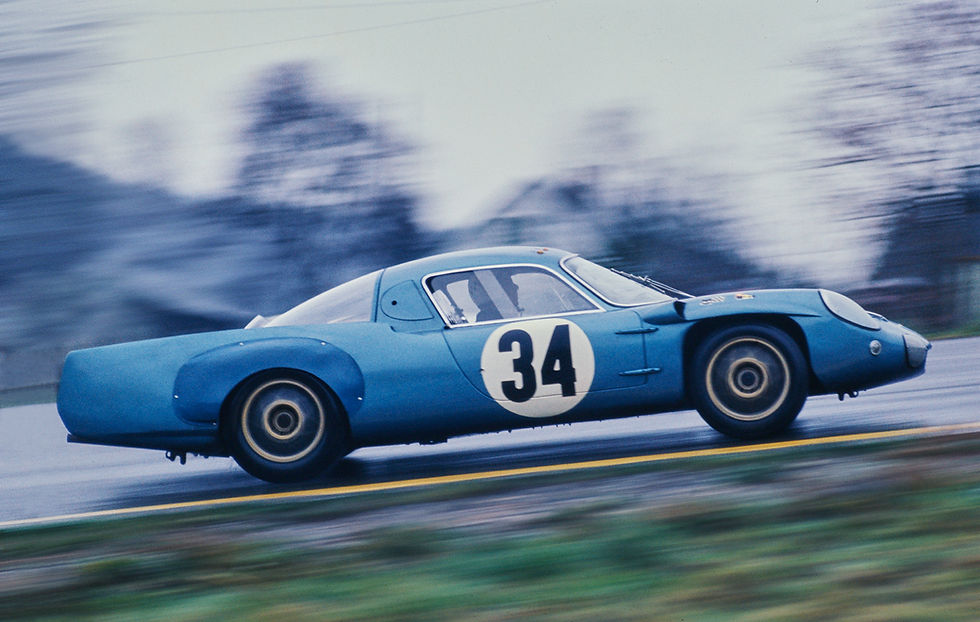
Between 1967 and 1969, the Alpine A210 represented a crucial step in the evolution of the brand’s Le Mans prototypes. Building on the experience of its predecessors, the M63/M64, it was specifically designed to be competitive in the 2-liter prototype class at the 24 Hours of Le Mans.
Under the guidance of Jean Rédélé, Alpine pursued a clear concept. Instead of relying on sheer engine power, the focus was on low weight, aerodynamics and efficiency. The A210 was the result of collective craftsmanship: the chassis was designed by Richard Bouleau, the body by Marcel Hubert and the engines came from the workshops of Amédée Gordini.
The engine was a heavily modified high-performance Renault four cylinder, prepared by Gordini, producing roughly 130–150 hp. While modest compared to the larger prototypes, Alpine compensated with low drag and exceptional reliability.
The A210 featured:
Lightweight tubular spaceframe chassis
Extremely slender fiberglass body
Mid-engine layout
In total, seven A210s were built and officially raced between 1966 and 1969. Among them, chassis number 1725,
built in 1967, has a particularly remarkable history.
A MODULAR POWERTRAIN
The chassis consisted of a steel tubular spaceframe. Suspension was conventional: double wishbones with stabilizers at the front and double wishbones with telescopic shock absorbers at the rear, developed by French manufacturer Allinquant, a historical Alpine partner in the 1960s.
The wheels were initially 15 inches, later 13 inches, the fuel tank held 79 liters and the engine was designated T58C, named after its designer, Amédée Gordini.
It was an inline-four, mounted longitudinally in a slightly inclined mid-engine layout behind the cockpit, non-load-bearing. A major advantage of this engine was its variable displacement configuration.
The engine block was cast iron, with an aluminum cylinder head. The forged steel crankshaft ran on five main bearings. The camshaft was chain-driven and crucially, the engine featured dry-sump lubrication.
Different versions of the Type-58 engine were identified by letters indicating displacement:
Description | Displacement | Note |
Typ 58 A | 1296 ccm | commonly used in smaller prototype classes |
Typ 58 B | 1005 ccm | optimized for the 1-liter category |
Typ 58 C | 1470 ccm | the largest variant |
The displacement could be realized in multiple configurations:
996 cc (bore × stroke: 71.4 × 62 mm) ~95 hp
1,001 cc (71.7 × 62 mm) ~95 hp
1,108 cc (71.7 × 69 mm) ~110 hp
1,296 cc (75.7 × 72 mm) ~130 hp
1,470 cc (79 × 75 mm) up to 160 hp with Kugelfischer fuel injection
Alpine used this variety of displacements between 1967 and 1969, depending on regulations and race requirements. Chassis 1725 boasts a particularly illustrious history, having competed three times at the 24 Hours of Le Mans –
each with a different driver pairing and engine displacement.

24 HOURS OF LE MANS 1967
JUNE 10 – 11, 1967
REASON AND PRECISION
In 1967 Alpine faced a crucial crossroads. True to the proven principles of field testing and gradual development, Richard Bouleau and Marcel Hubert consciously chose the path of reason over daring experiments. Instead of building an entirely new race car, they focused on modernizing the proven M 65 prototype, which had won the 500 km at the Nürburgring in the previous season. The resulting new Berlinette was now called the A 210 rather than M 66.
During the winter of 1966–1967, while the racing season still seemed far away and Alpine’s workshops were buzzing with activity, the last two examples of the Alpine A210 prototype were built. These were chassis 1725 and 1726 –
the final representatives of a series that had begun in 1966 with five cars. These final cars of the second series carried the experience of an entire racing year, incorporating small improvements, refined details, and the uncompromising will to perform on the grand stage of endurance racing.
Among them, chassis 1725 held a special place. This car was more than a race car – it was a concentrated piece of French engineering, built for speed and endurance. Beneath its low, aerodynamic body worked an engine from the school of Amédée Gordini: the Type 58 A, a 1296 cc four-cylinder, small in displacement but immense in character. High-revving, spirited and precisely tuned, it embodied Alpine’s philosophy: maximum efficiency through low weight and perfect balance.
The 24 Hours of Le Mans were defined by technical innovation, intense competition and tragic events. Alpine entered with an ambitious prototype program but suffered a setback. The new V8 prototype A211 was not completed in time. Therefore, the team relied on a fleet of proven A210 prototypes, entering seven A210s along with one older M64.
Aerodynamic details were only carefully optimized, while the spectacular new Michelin slick tires on 15-inch wheels and the special FERGAT magnesium wheels already hinted at Alpine’s technical innovation.
During the test weekend in April, Alpine showed clear progress. Mauro Bianchi set a historic lap time of 3 minutes 58.6 seconds, making the A210 the first French race car to break the four-minute barrier at Le Mans. Nevertheless, Alpine remained well behind the favorites. The high-powered prototypes from Ford and Ferrari reached significantly higher speeds on the Mulsanne Straight.
FERGAT WHEELS & MICHELIN SLICKS
MORE GRIP – LESS DRIFT
For Le Mans 1967, Rédélé urgently ordered 15-inch light-alloy wheels from Italy’s Fergat. During initial testing, however, it became clear that the casting was porous and air escaped through the internal channels – a risk that could have caused extra pit stops. The solution was to temporarily seal the wheels with Araldite.
Technologically, 1967 brought a major innovation. Michelin tested slick-like racing tires for the first time, without tread. Alpine drivers had to adjust their driving style because the tires allowed far less controlled drifting. After initial skepticism, the tests showed significantly faster lap times – an innovation that would profoundly change motorsport.
Michelin test driver André Pilette tested an Alpine A210 with the revolutionary treadless slicks at the Ladoux testing facility. At first, the car felt uncontrollable – it slid unpredictably, completely different from what was familiar.
It quickly became clear that these tires required an entirely new driving technique – no more slides.
Once he adapted his technique, the results were overwhelming. Lap records were shattered and grip rather than drifting dictated the pace. The tires, Michelin A1 Slicks, were then adopted for the 24 Hours of Le Mans 1967.
Alpine was the first team to use them in competition. The introduction was not without challenges. During the technical inspection, officials demanded that the unusual tires be replaced with conventional ones. Only Michelin’s authority, along with a signed waiver, allowed Alpine to run the slicks.
The use of the Alpine A210 with Michelin Slicks marked the beginning of a new era. Grip, precision and tire technology began to redefine endurance racing.

SMALL TEAM – BIG STAGE
On Saturday, June 10, 1967, Le Mans greeted the starters under a dull, overcast sky. No rain fell, yet the teams,
Alpine included, had rain tires ready – just in case. Fiftyfour cars lined up, drivers took their positions and as four o’clock approached, a tense silence fell over the grandstands and the crowded pit galleries. Then the flag dropped and
fortynine cars surged forward, while a few hesitated, including one Alpine. Panic and adrenaline mixed until finally everyone joined the race.
Alpine’s goal was clear – to shine in the indexes. But the competition was fierce, from Porsche to Ford’s seven-liter monsters driven by Dan Gurney and AJ Foyt. The new 1470 cc engine promised advantages over the 1296 cc Alpines, yet in reality the difference was small. In the end, it was car number 46, chassis 1725, driven by Henri Grandsire and José Rosinski with the 1296 cc Type T58A engine, that achieved Alpine’s highest result: ninth overall and first in the 1300 cc prototype class.
At the wheel of No. 46 were Henri Grandsire, a rising television star from his role in the series Michel Vaillant and his friend José Rosinski, with whom he had previously raced in Formula Junior. Rosinski would later become Alpine’s sporting director as well as a journalist and test driver for Sport Auto, the magazine founded in 1962 by Jean Lucas and Gérard Crombac.


PITFALLS AND TRIUMPHS
The race demanded full concentration and endurance. Car No. 46 ran faultlessly for long stretches, even reaching eighth overall at times. In the final hours, they battled stronger competitors, the Ferrari 275 GTB of Steinmann and Spoerry and the Porsche Carrera 6 of Poirot and Koch. A burst water pipe forced an unscheduled pit stop and cost valuable time. Adding to the drama, José Rosinski repeatedly believed he was going slower than expected, having read the wrong pit board – No.47 instead of No. 46. The mistake only became clear at the pit stop.

Just behind, André de Cortanze and Alain le Guellec in car No.49 fought for every meter. After an almost flawless drive interrupted only by a broken throttle linkage, they overtook the Ferrari 275 in the final hour, finishing tenth overall, second in the 1300 cc class and third in the Thermic Index. Car No. 48, the Alpine A210 of Jacques Cheinisse and Roger de Lageneste, crossed the line in twelfth place.
Mauro Bianchi and Jean Vinatier in car No. 45, the first 1470 cc model, experienced a race of relentless comebacks. From 31st place in the first hour, they climbed to 19th by midnight and led the Thermic Index. Recurrent brake problems repeatedly set them back. Through sheer persistence, they fought their way up to twelfth place – Bianchi’s best Le Mans result to date.
Not all Alpines reached the finish. Car No. 47 of Robert Bouharde and Jean-Claude Andruet was destroyed on lap 219. Car No. 56 of Larrousse and Depailler retired on lap 204 with engine failure, as did the NART M64 of Thérier and Chevalier. Car No. 58 retired as early as lap 67 due to oil problems.


Alpine once again demonstrated innovation and team spirit. Richard Bouleau’s lightweight central-nut wheels sped up pit stops and impressed the competition, while Michelin gained new insights into tire adhesion that would transform motorsport. The team’s familial atmosphere, with mechanics, drivers and wives sharing meals trackside, strengthened morale and cohesion – a clear contrast to the rigid hierarchies of other teams.
The 1967 24 Hours of Le Mans made headlines for Ford, yet for Alpine it was a race of courage, endurance and engineering skill. Between technical failures, tactical decisions and innovative breakthroughs, the team proved that passion, teamwork and ingenuity could shine even in the toughest endurance race in the world.

Crossing the finish line, drivers and mechanics alike exhaled. Twentyfour hours, countless laps, endless decisions in fractions of a second – and in the end, the Alpine A210 triumphed, a symbol of French engineering, team spirit and the indomitable will to make the impossible possible.
12 HOURS OF REIMS
24–25 JUNE 1967
DAVID AGAINST GOLIATH
The 12 Hours of Reims in 1967 was more than just a race – it was a celebration of speed and endurance, returning to the motorsport calendar after nearly a decade of absence. The event took place on June 24–25, just two weeks after the grueling 24 Hours of Le Mans, yet the workshops of Alpine and the other teams were already buzzing with activity.
The Automobile Club de Champagne organized a spectacular weekend. Alongside the 12-hour main race, there were Formula 2, Formula 3 and Renault-Gordini races – a true festival of engines.
Jean-Louis Marnat / Roger de Lageneste, Nr. 66, Chassis No. 1724
From Wednesday to Friday, practice sessions took place under oppressive summer heat, with thunderstorms threatening, adding tension to the preparations. Alpine, however, had to manage without the new A211. Instead, four A210s and a single 1150 cc Berlinette entered the race. Two cars with 1470 cc engines competed in the 1301–1600 cc class, while two with 1296 cc engines ran in the 1001–1300 cc class.
Chassis 1726, fresh from Le Mans, was entrusted to Mauro Bianchi and Jean Vinatier. Car No. 55 from Ecurie Savin-Calberson started from 20th position with a time of 2:30.3 minutes, right alongside chassis 1724, car No. 54, driven by Henri Grandsire and Patrick Depailler. André de Cortanze and Alain le Guellec in the 1296 cc A210 No. 65 started 24th, while Jean-Louis Marnat and Roger de Lageneste in car No. 66 occupied 26th on the grid.
On Saturday, the race began traditionally with a night start in Le Mans style. Under floodlights, Toto Roche dropped the flag and the drivers ran to their cars before the engines roared to life. In the first hour, Bianchi and Vinatier had already moved up to 15th place, with Grandsire and Depailler following in 17th. By the second hour, Bianchi had climbed to 12th – until the engine failed in the fifth hour. From the fourth hour, Grandsire and Depailler’s car gradually fell back, and in the seventh hour, the race ended prematurely for them when the 1470 cc engine suffered a broken connecting rod – the same issue that had already struck Bianchi and Vinatier’s sister car.
Alpine had placed high hopes on the 1470 cc engines, but reliability proved to be the limiting factor. The failures highlighted the fragility of the experimental 1470 cc motor, while the smaller 1296 cc A210s proved far more dependable. Meanwhile, the 1296 cc car of Marnat and de Lageneste steadily moved forward, a textbook example of consistency and speed. Two hours from the finish, they were already in eighth place – an impressive performance in a field dominated by larger engines. Car No. 65 of de Cortanze and le Guellec showed a similar performance, finishing just behind their sister car.
In the end, Alpine’s results were mixed but respectable. Car No. 66 won the Sports Prototype 1001–1300 cc class, while car No. 65 finished second. Overall victory went to Jo Schlesser and Guy Ligier in the powerful Ford Mk II 7 L, completing 296 laps of the 8.3 km Reims circuit.
Despite the disappointments, the appearance of Grandsire and Depailler in A210 No. 54 remains a small but remarkable chapter in Alpine’s late-1960s endurance racing program, illustrating both the potential and the growing pains of the lightweight Dieppe prototypes in Alpine’s pursuit of class victories at major European endurance events.
The 12 Hours of Reims 1967 was a race of extremes. Once again, Alpine demonstrated that in motorsport, speed alone is not enough – reliability, strategy and courage create legends.
500 KM NÜRBURGRING
3 SEPTEMBER 1967
DRAMA ON THE NORDSCHLEIFE
On 3 September 1967, Henri Grandsire returned with the Alpine A210 chassis 1725 to one of Europe’s most demanding circuits – the legendary Nürburgring Nordschleife, host of the 500 km Nürburgring 1967. For Grandsire,
it was more than just a race – it was a personal statement. To make his car immediately recognizable, he had a small checkered flag painted on the roof behind the windshield, mirroring the one on his helmet. This detail was more than decoration – it was a personal signature, a piece of identity. Remarkably, these checkered flags remained permanently on 1725 – a quiet yet distinctive hallmark of this chassis.
Beneath its long, slender bodywork now roared the most powerful Gordini engine of the series, the Type 58 C with 1470 cc. This four-cylinder, developed by Amédée Gordini, gave the lightweight prototype more power and torque – exactly what was required on the demanding Nordschleife.
The stage was set: 22 merciless laps over the 14.189-mile Nordschleife, a total of 502 km, with the championship title hanging in the balance. Abarth, lurking in the background after more completed races, aimed to spoil Alpine’s triumph – the tension was tangible in the cool, cloudy air.


From the start, Alpine showed its dominance. Pole position went to Mauro Bianchi with a breathtaking lap, followed by Henri Grandsire and Patrick Depailler. At the start, Grandsire initially took the lead, but overheating stopped him in lap three. Bianchi assumed command and set a blistering pace, only to make a brief pit stop for brake issues, handing the lead to Depailler. With flawless precision, he carried the race through the first half, mastering every corner.
Yet the Nürburgring, merciless as always, demanded its toll. Depailler’s run ended with a cruel twist of fate when the gearbox finally failed. Alpine faced another harsh setback. The race offered moments of pure brilliance, strategy and speed on one of the world’s toughest circuits, but in the end, technology had the final word.
The 500 km Nürburgring race of 1967 was a testament to Alpine’s spirit – bold, fast and yet at the mercy of mechanical whims. Winning here was never easy and for Alpine, the drama remained unforgettable – just like the track itself.

9 HOURS OF KYALAMI
4 NOVEMBER 1967
ALPINE DEFIANT IN THE AFRICAN HEAT
While Alpine’s workshops in Dieppe were running at full speed, a special request came from Renault. One car was to be sent to the 9 Hours of Kyalami to support Renault’s new business in South Africa. Alpine responded with determination, preparing the A210 chassis 1725 with the 1470 cc engine, to be driven by Henri Grandsire and Patrick Depailler.

On 9 November 1967, the famous Kyalami circuit welcomed 80,000 spectators under the blazing sun. Temperatures soared well above 40 °C and the asphalt seemed to burn. At 2 p.m., the start flag dropped in classic Le Mans style:
the drivers ran to their cars, engines roared and the race was underway.
In the first two hours, the Alpine quietly and steadily moved through the field, initially invisible on the leaderboard.
Yet patience, precision and reliability were about to pay off. After four hours, Grandsire and Depailler reached sixth place, behind the powerful Mirages, Lolas and Fords – but ahead of a Ferrari. The little Alpine, outgunned in raw horsepower, proved that precision, consistency and courage can sometimes matter more than brute power.
As the race progressed and the heat eased, thrilling duels ignited on the track. After seven hours, the Ferrari pairing of Attwood and Piper regained sixth place, dropping the Alpine to seventh overall – a position it held until the finish. Additionally, the A210 earned fourth place in the Performance Index, a recognition of efficiency and reliability over the nine-hour race.
For Alpine, Kyalami was more than a result. It was proof of the team’s capability even outside Europe. Kyalami 1967 remains unforgettable: a small French car battling the giants under the African sun, exceeding expectations and showing that heart and skill can sometimes outweigh raw engine power.
1968 – TRIUMPH, DRAMA AND THE WHISPER OF SPEED
ANNIVERSARY AT CHARADE
1968 became the glorious year of the Alpine A210 chassis 1725.
A year full of appearances, experiments, setbacks and high hopes – a year in which this slender French prototype repeatedly returned to the international motorsport stage.
The season did not begin with a race, but with a celebration. At the spectacular Circuit de Charade in Clermont-Ferrand, a track that winds like a mountain pass through the Auvergne, Alpine celebrated its tenth anniversary.
At the wheel of 1725 sat Gérard Larrousse, one of the great French drivers of the era. His demonstration laps were more than a show – they were a tribute to a decade of passion, engineering mastery and racing courage from Alpine.
24 HOURS OF LE MANS 1968
28–29 SEPTEMBER 1968
September 1968 brought Le Mans fans a race under unusual circumstances. France had been shaken in May by student unrest and nationwide strikes, and the traditional ACO June date had to be postponed to mid-September.
The atmosphere around the 24-hour race reflected a mix of anticipation and caution – a mirror of the societal changes of the time.


For Alpine, this presented an unusual opportunity. The team, now under the sporting leadership of Jacques Cheinisse, deliberately chose a young driver pairing.
On chassis 1725, they placed the two talented rally drivers Jean-Pierre Nicolas and Jean-Claude Andruet, who had already proven their skills on rally stages.
For the endurance challenge of Le Mans, this was both a risk and a chance to combine fresh talent with driving expertise.


The Alpine A210 1725 was equipped with the 1,001 cc engine and raced under number 55. To make the cars easier to identify in the pits – Alpine entered four more A210s and four A220s – each car received a distinctive band above the windshield. Chassis 1725 bore its characteristic checkered pattern, immediately noticeable amid the hectic pit activity.

Once the start flag fell, a race full of trials for both drivers and machine began. Despite the small engine, the A210 demonstrated remarkable reliability. Jean-Pierre Nicolas and Jean-Claude Andruet swapped stints smoothly, navigating the long, demanding Le Mans circuit with precision and maintaining the calm required through the night hours of a 24-hour race.


Hours passed, tires were changed, tanks refilled and the small Dieppe team worked meticulously. While the larger 2-liter and 3-liter prototypes raced with raw speed, the A210 played to its strengths: light weight, efficient chassis and low fuel consumption. Each lap brought the Alpine closer to the finish line, proving that precise engineering and smart driver decisions often outweigh pure horsepower.
When the checkered flag fell after 24 hours, the Alpine A210 chassis 1725 had not only endured the race but achieved an outstanding result. Fourteenth overall, well ahead in a field dominated by faster sports cars. More importantly, the A210 won the Index of Performance and claimed the class victory in the up-to-1,150 cc category.
A triumph honoring both the young driver team and Alpine’s engineers, affirming the philosophy of the house:
clever design, reliability and efficiency triumph over raw power.


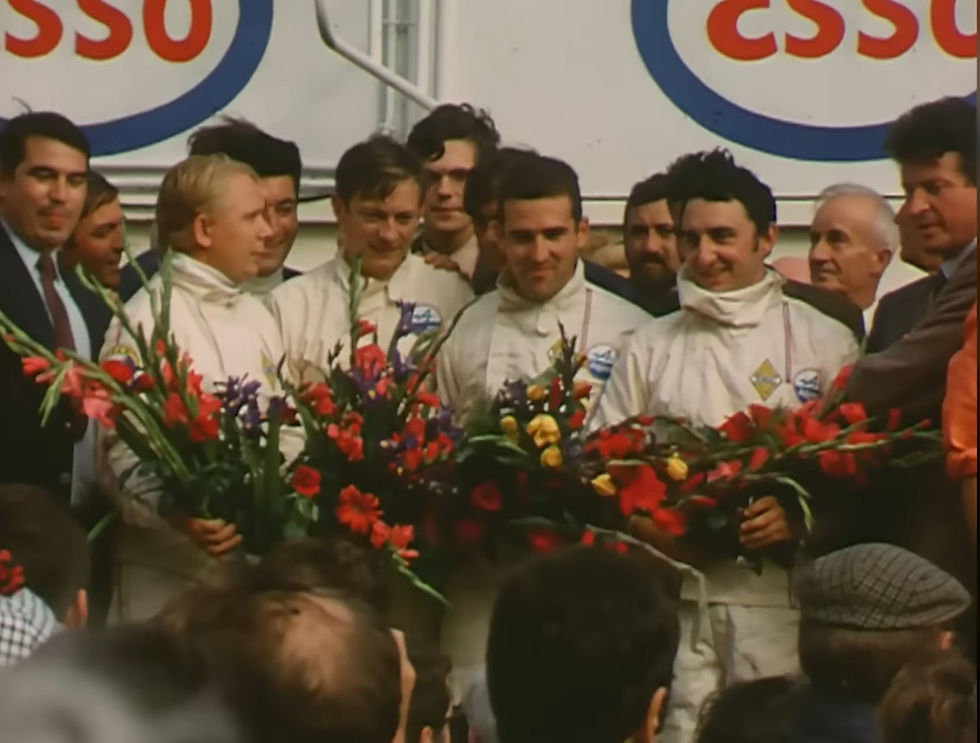
The Alpine A210 1725 and its young drivers Nicolas and Andruet proved that even a small, cleverly engineered car with brave drivers can shine on the biggest stage of endurance racing. The 1968 race will be remembered not only as a sporting success but as a symbol of a new generation emerging in Alpine’s motorsport history.
500 KM NÜRBURGRING 1968
4 AUGUST 1968
THE MOVIE STAR FROM MICHEL VAILLANT – HENRI GRANDSIRE AT THE WHEEL
August 4, 1968, dawned as a clear summer morning over the legendary Nürburgring Nordschleife.
For the drivers, this meant 500 kilometers across 22 kilometers of pure challenge, over 150 corners, steep climbs and rapid descents – a race that tested both man and machine.

Behind car number 8 stands the Alpine A210 chassis 1725, ready for battle. Behind the wheel Henri Grandsire,
an experienced driver who knows exactly how to showcase a light, agile car on the Nordschleife.
Equipped with the proven 1,001 cc engine, the A210 may seem small compared to the larger prototypes of its competitors, yet it is nimble, precise and unshakably reliable.

At the drop of the flag, Grandsire launches the Alpine into motion. On the long straights, the little car may appear outmatched, but in the fast corners and technical sections of the Nordschleife, the A210’s true strengths shine:
precise handling, balanced behavior and an efficient engine that delivers consistent power without overheating.
Hour after hour, Grandsire works through the field, weaving past slower cars, following the ideal line with unwavering focus and keeping the pace high. The pit crew operates with practiced efficiency: tire changes, refueling and quick technical checks are executed smoothly, keeping the A210 continuously on track and proving the chassis’s reliability.

After 500 kilometers, when the checkered flag falls, the results reflect the hard work and skill of the small team from Dieppe: 9th place overall for the Alpine A210 1725 and a commanding victory in its engine class up to 1,150 cc. Grandsire and the engineers once again demonstrated that precision, endurance and clever design can matter more than raw power – especially on a track like the Nürburgring.
The A210 1725 confirmed what Alpine stands for: a car that impresses through lightness, driving feel and reliability, capable of competing even against far more powerful rivals. For Henri Grandsire, it was a day when driving skill, technical ingenuity and teamwork came together perfectly.
24 HOURS OF LE MANS 1969
JUNE 14–15 1969
FRENCH COURAGE MEETS SPANISH PRECISION
The 24 Hours of Le Mans, as always, was an epic battle of speed, endurance, and engineering. This year, Alpine returned with its light, arrow-straight A210s, cars focused on reliability and handling across the long, technically demanding sections of the Circuit de la Sarthe.


The A210 carrying number 46 had a special driver pairing. Hervé Le Guellec, not only the head of a metalworking company but also an Alpine dealer, brought both financial backing and sharp business acumen to the track.
At his side was Bernard Tramont, a rally-experienced driver from Spain who, with support from FASA (Fabricación de Automóviles Sociedad Anónima), had already achieved impressive results in Spanish motorsport.

On the track, chassis 1725 danced nimbly and silently between the heavy prototypes and GT monsters of the major manufacturers. Its light weight and aerodynamic shape made it exceptionally quick in the corners of the Sarthe,
but every lap demanded absolute focus. The North and Mulsanne straights tested top speed, while technical sectors such as Indianapolis and Arnage challenged the drivers’ skill.
The opening laps were a demonstration of courage and driving finesse. The A210 1725 leveraged its lightness and agility, mastering tight corners and the rises and falls of the circuit with impressive precision. Yet after only two hours—barely had the race begun—dreams were abruptly shattered. A failure of the cylinder head gasket forced the duo to retire early.
For Alpine, it was a bitter setback. The engineers’ months of preparation and the drivers’ trust in their car ended abruptly. But this early exit tells its own story: of the risks of motorsport, the fragility of even the finest machines and the determination required simply to compete on the legendary track.
The Alpine A210 1725 may not have crossed the finish line, but it left its mark on history as a symbol of the tireless pioneering spirit of a small brand standing up to the giants of racing—even when fate proved merciless.
THE FORGOTTEN HEROES OF AVENUE DE BRÉAUTÉ
After the end of its active racing career, the Alpine A210 Chassis 1725 entered a new, almost equally dramatic chapter—one in which its fate remained uncertain for a long time.

Chassis 1725 first returned to the care of Alpine’s motorsport department, then located on Avenue de Bréauté in Dieppe. There, many of the once-glorious prototypes were parked—cars that had, just a few years earlier, competed on tracks like Le Mans and the Nürburgring.
But the priorities of the brand had shifted. In the late 1960s and early 1970s, Alpine increasingly focused on rallying. This strategy would eventually culminate in triumph: in 1973, Alpine won the World Rally Championship with the legendary Alpine A110.
For the older prototypes, however, this change brought harsh realities. Many of the former race cars were left outside, exposed to the elements, forgotten as new generations of competition vehicles took center stage.
Some were even cannibalized for parts—engines, gearboxes, and suspension components removed to keep other projects alive. That Chassis 1725 escaped this fate is almost a small miracle.
THE SECOND LIFE OF 1725
On June 22, 1970, the chassis was finally sold—to Christian Martin, an engineer at Renault. For him, the A210 was far more than a former race car—it was a piece of modern motorsport history.
At that time, the car was remarkably well-equipped. In its rear sat the Type 58C engine number 12, a 1470 cc Gordini unit—the very engine Henri Grandsire had raced in the 500 km Nürburgring 1968.
A Porsche gearbox number 8 transmitted the engine’s power reliably to the rear wheels. As if that weren’t enough, Martin also received six magnesium center-lock wheels—true racing components, lightweight and uncompromisingly functional.
A BRIEF INTERLUDE
Yet, as fascinating as this prototype was, Christian Martin kept it for only a short time.
By September 18, 1970, Chassis 1725 changed hands again. The new owner was Gérard Gombert from Antibes on the French Riviera.
Thus began another chapter in the life of this former Le Mans competitor, far from the major race tracks. Looking back, the post-racing history of Alpine A210 Chassis 1725 is especially remarkable. Many of its sister cars disappeared over the years—dismantled, restored, modified, or modernized. Yet Chassis 1725 survived untouched.
It escaped the fate of many prototypes of its era, slowly vanishing in the workshops of racing departments. Instead, it found its way into the hands of Gérard Gombert, who recognized its value. And for that reason, today this chassis tells a story not just of races, drivers and engines—but of chance, decisions and the people who ensured that a small piece of Alpine’s great motorsport history endured.
GÉRARD GOMBERT – THE GUARDIAN OF THE A210 1725
“LA GOMBE” and the “LONG TAIL”
Gérard Gombert, known to everyone as “La Gombe,” was already a legend in his own lifetime — a one-of-a-kind personality, a man whose passion for engines and speed ran through every fiber of his being.
Born on May 16, 1939, in Paris, his youth was spent under the sun of the Côte d’Azur, where his family sold ice blocks after the war.
From an early age, he soaked up the world of machines like a sponge. His father, himself a motorcycle racer, showed him that life could exist beyond the ordinary.

In 1956, at the age of seventeen, Gérard entered his first hill climb in Fayence. It was not just a race, but an initiation: the smell of hot asphalt, the roar of engines, the wind in his hair. He immediately felt that he was born for adrenaline, that the road would be his element — long before he entered the world of sports cars.
In the late 1960s, he first opened a small workshop in Juan-les-Pins, then moved to Antibes, where he specialized in the then-rare polyester cars — Alpine, Lotus and other lightweight masterpieces. He made his own molds, repaired and perfected bodies and quickly became the go-to man for anyone seeking something exceptional. Soon, regional drivers and even the Alpine factory sent cars to him for maintenance before the Monte Carlo Rally.

His life was always a dance between work and pleasure. Gérard loved the company of artists and musicians.
Johnny Hallyday, Christophe, Nicoletta, Dick Rivers — all visited his workshop to watch him work on the finest cars.
In his hands passed AC Cobras, Porsche 904s, Lotus Elans, Lamborghini Miuras, Ford Mustangs — and finally, the Alpine A210, which he simply called the “long tail.”
The arrival of the A210, a Le Mans prototype, in La Gombe’s hands was a special moment. Previously, it had belonged to Renault engineer Christian Martin, who only owned it briefly. Equipped with the 58C engine No.12 —
the very engine with which Henry Grandsire had placed fourth in the 500 km Nürburgring in 1968 —
and a Porsche gearbox No. 8, it also came with six magnesium center-lock wheels.
On September 18, 1970, Gérard Gombert acquired the car. For him, the A210 was not just a machine —
it was a living camera of life. Every detail, anecdote, repair and race was a living archive.

In his hacienda in Fayence, purchased shortly after acquiring the car, he set up several garages. There, he collected crashed cars, spare parts, and motorcycles. Above his bed rested the legendary Norton Manx, supposedly a gift from Emperor Bao Dai, a silent reminder of past racing adventures. But the A210 remained at the center of it all.
With a Berlinette license plate, he drove it regularly on the roads, testing corners, accelerating along country roads and visiting the newly opened Circuit Paul Ricard.
Some nights, Gérard would drive alone with the A210 through the Provence countryside, while the hacienda’s dogs followed him and Pompon, his donkey, brayed from the pasture as if to say, “You belong here, just like this car.”
By the early 1980s, the hacienda had become a kingdom of engines, chassis, tools and vehicles — a place where chaos and order coexisted in an odd symbiosis. Gérard rescued accident-damaged vehicles, restored them, and maintained them with a dedication only a true enthusiast could muster. The Alpine A210, his A108, Françoise Sagan’s AC Bristol, Christophe’s Miura — all found refuge and protection with him.
Gérard Gombert was a storyteller, sharing his adventures on two and four wheels with humor, sometimes embellished, but always heartfelt. He knew every circuit visitor, every driver and his address book was a treasure for anyone who understood motorsport in southeastern France. He moved freely at Circuit du Castellet, often sailed on Paul Ricard’s boat, yet he remained, above all, a man who loved his machines above everything.
The key to a good relationship with Gérard Gombert was never to push him or try to buy from him. He rarely parted with his vehicles or motorcycles. He occasionally negotiated, but mostly spent his time celebrating with friends, especially enjoying Provence rosé, the glass always half full, the mood light. Around him, passion, enjoyment and genuine friendship took precedence over business ambitions.
Under his care, the Alpine A210 entered a new life cycle. In mysterious circumstances, he even obtained a road registration in 1983 under the number 3683 XB 95 and drove it on public roads as if it were the most natural thing in the world. For him, it was always more than a car — it embodied memory, adventure, passion and freedom.
After the death of his father in the late 1990s, Gérard Gombert ceased all his activities. The places once filled with the energy of motorsport and vehicle passion fell into disrepair. Few visitors remained; items piled up into unmanageable heaps, and his house became nearly inaccessible. A sad retreat of a man once considered the guardian of an automotive treasure. Unfortunately, he suffered from hoarding disorder; in March 2016, he was hospitalized psychiatrically and died a few days later.
The tragedy did not end there. After his death, his unprotected estate was looted. His Norton Manx, Miura engines, numerous Alpine parts, and even parts of the AC Bristol were stolen. Fortunately, the engine and gearbox of the Le Mans Alpine Chassis1725 were almost fully saved. But the cylinder head was gone, a visible symbol of the losses endured by this legend.
Thus, the story of La Gombe and his A210 remains unforgettable: one man, one car, a life full of passion, chaos, freedom and boundless love for motorsport.
GRATITUDE AND HONOR TO THE GUARDIAN OF THE A210 1725
Gérard Gombert ensured that the engine, gearbox, chassis, and history of this unique prototype were not lost forever — that they would remain visible, tangible, and preserved for future generations.

Gérard Gombert ensured that the engine, gearbox, chassis, and history of this unique prototype were not lost forever — that they would remain visible, tangible, and preserved for future generations.
The story of the A210 chassis 1725 reflects the glorious yet often fleeting world of motorsport. From legendary races at Le Mans and the Nürburgring, to demonstration runs at Charade, and finally the quiet years in private hands. Many of its sister cars vanished over time; some were “cannibalized,” others forgotten.
Yet Gérard Gombert stepped in like a guardian of a lost treasure. Thanks to his passion, patience, and unwavering determination, 1725 survived nearly untouched.
Even the tragic final years of Gombert could not destroy 1725’s legacy. Although parts of the car and many other treasures were looted after his death, the core of the racing car endured. Today, A210 chassis 1725 stands not only as a technical masterpiece but also as a living chronicle of the passion, courage, and friendships that surrounded it.
Thanks to Gérard Gombert, the story lives on — tales of victory and defeat, courage and elegance, French engineering and motorsport passion — captured in every single component of 1725.
SEARCH AND RESCUE
My Journey to the Alpine A210, Chassis No. 1725
There are dreams that stay with us for a lifetime.
They mature quietly in the background, nourished by memories, encounters and passion.
The acquisition of perhaps the most significant vehicle in Alpine’s history – the A210 with chassis number 1725.
The most extraordinary A210 among the mere 7 ever built – the former Le Mans Alpine of Gérard Gombert –
a car that wrote motorsport history and to which I have a personal connection.
REVIEW
A Pilgrimage of Rust and Glory – The Forgotten World of Gérard Gombert
Two Encounters with Gérard Gombert
In the quiet hills on the edge of town, where fox and hare bid each other goodnight, lived Gérard Gombert –
an eccentric old hermit. For decades, he had withdrawn from the world, surrounded by rusty treasures and dented relics of automotive history. His scrapyard was an enchanted place, wrapped in legend and mystery.
My first encounter with Gérard Gombert dates back to 2001.
Back then, we visited him at his legendary scrapyard in Fayence, right in the heart of Provence.
A place seemingly frozen in time, filled with rusting gems, caught in a Sleeping Beauty-like slumber. Old Renaults, Peugeots, and Mercedes – all covered in the dust of the years, yet brimming with stories.
We helped him tow his broken-down Mercedes “Strich 8” – an absurd, almost cinematic scene that would become the beginning of a very special connection.
The Magic of Decay
I saw Gérard a second time in the summer of 2010. There were no signs pointing the way, no entries on maps or websites. Those who found the place had truly earned it. And those who entered fell silent. The wind whispered through shattered windows, birds nested in engine blocks – and Gérard, usually barely dressed, greeted us with a friendly wave at the gate of his domain as we arrived.
Over a glass of rosé amidst the dusty rarities, we listened to his stories – endless, fantastic, bizarre and full of passion. Gérard rarely spoke much, but when he did, every word was like a little poem made of gasoline, memory and mechanical philosophy. His knowledge was vast, his collection inexhaustible, his gaze dreamy and rooted in the past. Gérard spoke for hours about his life, about cars, motorcycles, races, dreams. The hours passed like minutes.
In the end, we said goodbye warmly. We left Fayence not only with lasting impressions – but as friends.
Gérard Gombert`s legacy
In April 2016, Gérard passed away – a loss that left a deep mark in the community.
It felt like a chapter of motorsport history had closed forever.
At the auction of his estate, I was determined to bid for the A210.
I was there – ready to go all in – but the price skyrocketed beyond reach and another enthusiast won the day.
Crowned Awakening
In the darkness of the abandoned barn—without doors, without windows—she lay hidden.
Alpine A210 chassis no. 1725. A torso of decaying stone and rough-hewn wood surrounded her, as if she were resting in a silent prison. Layers of dust had settled over years in every groove and notch, as though preserving the whisper of her story. Victories, breakdowns, the bitter scent of gasoline in the air at Le Mans.
I stepped closer. In the faint, dim light, I recognized something unbelievable. The genuine laurel wreath of the class winner—yellowed yet still majestic—still lay upon her roof.
The wreath was a silent testament to a class victory that no one would ever celebrate again—
and yet it was here, as if it had grown into the car itself, determined that the memory of that triumph would never fade.
In that moment, I held my breath. Dust danced in the beam of light, as though escorting the car in one last victorious procession. I felt my heart pounding in time with the vision unfolding before me: the racetrack, the roar of engines, the cheers of the crowd at the Circuit de la Sarthe—and above it all hovered the laurel wreath. The crowning touch of the scene, a symbol of eternal remembrance that even decades of oblivion could not break.
There she stood now—freed from her stony prison, ignited by the first ray of sunlight.
Liberation means Farewell
A dull thud echoes through the valley of Fayence. A hole—rough, almost primal has been smashed into the old stone wall. And through this rupture, like a crack in time itself, light penetrates the crypt for the first time in decades. Dust swirls, sunbeams reach in, as if to make sure it’s real.
There she stands. Alpine A210, chassis no. 1725. Imprisoned, forgotten, buried under rubble and silence for over 40 years. And yet, intact, proud, aged with dignity—like an Egyptian mummy in her stone sarcophagus. Her bodywork bears the marks of time, not as flaws, but as testimony to a life once lived on the racetrack—at Le Mans, 1969.
Slowly, reverently, the enthusiasts approach. No sudden movements, no noise—just the soft creak of a jack, the scrape of tires on gravel, the murmurs of voices still in disbelief. The tires, flat and weary, still carry her weight. The wheels turn—freely. The brakes are not seized. It’s as if she had only been asleep all these years.
Then she rolls out, into the light, into freedom. The old country road, just meters from Gérard Gombert’s scrapyard, becomes her stage. Onlookers stop, pull out their phones, speak in hushed excitement. A child asks his father what kind of car that is. “A legend,” he replies. And so she is.
By the roadside, the transport truck waits. Its metal frame gleams in the sun, ready to carry her into a new chapter. One last glance back at the broken wall, at the scrapyard now silent again. The place that once swallowed her now lets her go. A moment full of reverence, gratitude and a touch of sorrow. The Alpine leaves her realm of silence and returns to the world. Not restored, not reborn—but authentic, alive and ready to write a new story.
Photos: „Phares Jaunes et Damiers“
Second Life
RM Sothebys Auction - Le Mans Classic 2023
The Dream That Almost Became Reality
On June 9, 2023, the auction house RM Sotheby’s wrote a very special chapter in motorsport history. As part of the Le Mans Centenary Auction, a legend went up for sale—the 1967 Alpine A210.
Not just any car. This was a piece of racing heritage. Unrestored, clad in patina, frozen in time—entombed for over 40 years in a time capsule on Gérard Gombert’s scrapyard.
A machine born for efficiency and elegance, engineered to extract every last drop of fuel. Not for the brute force of the fastest laps, but for a clever interplay of physics, aerodynamics and weight. The Alpine was Le Mans’s quiet hero—designed to dominate the Index of „Thermal Efficiency“. And she was breathtakingly beautiful.
Bidding War – The Fierce Duel for the Alpine A210
I knew her before she even hit the block. I had once seen her live—through a crack in the masonry at Gérard Gombert’s scrapyard. Then again, in 2016 at the Fayence auction, where she was freed from her sarcophagus and saw the light of day once more.
Countless times I had studied her on photos, in videos and old archival footage. Those lines, that color, that aura. I had dreamed of owning her and now she was just one click away.
My heart raced as the bidding war began. I had set my limit, crunched the numbers, made my plan and nurtured my hope. With trembling fingers I placed my first bid. The numbers climbed, my pulse soared—for a fleeting moment I was ahead. But then,a new bid, higher and another. I hesitated, I battled with myself. A bit higher? But there it was—my limit. I couldn’t go on. The number on the screen froze.
Unsold – Reserve Not Met.
I knew what it meant. The reserve price hadn’t been reached. She remained unsold. No new owner, no new beginning. She would roll back into a dark hall, vanish again—at least for a while.
The A210 at auction - watch the video here:
1967 Alpine A210#1725
Only a few Le Mans veterans boast as impressive a track record as this Alpine A210. She competed in the grueling race three times between 1967 and 1969, achieving ninth place overall and first in the under 1.3-liter class on her debut attempt. In 1968, rally aces Nicolas and Andruet managed 14th place overall, first in the under 1150 cm³ class, and claimed victory in the Index of Performance. Its final outing at Le Mans was less successful—she retired after just two hours due to a blown cylinder head gasket.
This already rare car—only seven A210s were built—also raced in the 12 Hours of Reims, the 500 km of Nürburgring, and the 9 Hours of Kyalami.
After her active career, she ended up in the hands of mechanic, motorcycle racer and collector Gerard “La Gombe” Gombert, who bought her in 1971 and kept her (unrestored) until his death 40 years later. Shortly thereafter, she was sold for €710,000 at the Etude Osenat auction house. She was then mechanically overhauled, with her wonderful Le Mans patina preserved.
Source: Classic Driver
Photos: Remi Dargegen
OUTLOOK
December 2024 – The Turning Point
Then suddenly, in December 2024, the unexpected happened – the A210 resurfaced, this time for sale at Ascott Collection in France. I didn’t hesitate for a second – I wanted to try my luck once more. I submitted an offer.
What followed were three nerve-wracking days full of phone calls, negotiations, hope and anxiety.
Other interested parties were in the game and the A210 was actually set to be exhibited at Retromobile in Paris in February 2025.
I knew that once it appeared in Paris, it would be lost to me. I had to go all in now!
The Moment of Truth
The decisive moment came when the owner saw my website and my work around the Alpine A110.
He recognized the seriousness of my passion, the depth of my connection to the Alpine brand.
He must have sensed that this car would not disappear into a collection with me, but would embark on a new chapter.
A chapter defined by appreciation, technical expertise and genuine Alpine passion.
He saw that I wasn’t a speculator, not a dealer, but a lover and caretaker, an enthusiast – a part of this story.
Then the final call came from Xavier Micheron, the head of Ascott Collection, who played a key role in ensuring this special Alpine A210 would find its way into my hands:
“The car is yours”
A Legend Comes Home
I will never forget that moment – my heart pounded like the start of an endurance race.
Two decades of longing, setbacks, hope – all found their meaning in that one instant.
The A210 Chassi No.#1725 is coming home – into my collection, into an environment
where she is not only admired, but respected and understood.
She carries the DNA of Le Mans and their former pilots, the breath of Gérard, the blood and sweat of countless mechanics, engineers, drivers. She is now part of my story – a story that will continue to be written.
With every oil change, every drive, every second I start its engine.
She is a witness of time, a soul on wheels, a legend as beautiful as the Mona Lisa.
Yes indeed, truly, the Blue Mauritius of all Alpines.
Art on Wheels – finally Home
And then she was there, sitting on the trailer. Wrapped in the crisp morning air as I picked her up in France.
A monument of motorsport history, loaded onto my humble trailer. It was an almost surreal sight.
The return journey – a long drive across half of France, one pit stop only, no stop over, no risk, straight home as fast as possible. Kilometer after kilometer, the landscape passed me by, but my eyes kept drifting to the rearview mirror.
There she lay – calm, powerful, majestic. A legend coming home.
It felt as if a circle had finally closed. As if history itself had been waiting for this very moment. Everything has its time.
I look at her and think of Le Mans, of Gérard, her former pilots, of all the mechanics, drivers, dreams, nights filled with the smell of oil and gasoline, the roaring noise..., the racing heart. And now—she's part of my life, part of my story.
She has arrived. And so have I.
BLOOD, SWEAT & TEARS
THE RESURRECTION OF A210 1725
REVIEW: 2016
The Alpine A210 chassis 1725 was more than a car for its new owner,it was a piece of living history,
a prototype that had experienced the 24 Hours of Le Mans three times, that had battled on the Nordschleife and proudly completed its laps on the Circuit de Charade.
Its new owner knew that this would not be an ordinary restoration. The task required patience, passion, and precision, and so the journey led to Carqueiranne, to Marc Ollier, where experience, craftsmanship and attention to detail are at home.
The first gifts of history came from Jean-Charles Rédélé, the son of the founder.
He handed over the missing but essential parts for the engine to the new owner: cylinder head, valve cover, timing case cover and dry-sump pump—directly from the legendary Boulevard Victor, the home of the Gordini workshops, arranged through the specialist Christian Huet.
On the extensive property, they also discovered the rare original jack of the prototype and the original magnesium wheels, which were later passed on to the fortunate buyer of 1725. Small treasures that bore witness to a life full of races and adventures.
The restoration was not meant to be a simple overhaul, not merely the revival of an old engine.
It was a mission, a passion, an act of preservation. In Marc Ollier’s workshops in Carqueiranne near Hyères, the story of 1725 took a new turn. Raymond Cayol, a master of his craft, took charge of the mechanical work, while Ollier focused on the prototype’s outer shell. Specialists who had already worked on Alpine Le Mans prototypes for JC Rédélé and Hervé Charbonneaux were now at work to preserve the spirit of the car.
The engine, based on the legendary 12C, was revised down to the smallest detail.
Rocker arms, valves, springs, pistons, rings, bearings, and gears were replaced or refurbished.
The Porsche gearbox was inspected, aircraft-type flexible fuel tanks renewed, and the brakes and electrics completely overhauled. Even the shock absorbers had to be newly manufactured, as identical originals no longer existed. The exhaust manifold was newly produced in Haute-Savoie at the renowned Établissements CHABORD according to the original specifications—each piece a small work of art.
But the true magic lay in the bodywork. The goal was clear—to preserve the original condition as much as possible.
The rear window was adapted by JC Rédélé and the missing small luggage-compartment flap was newly fabricated in accordance with Le Mans regulations. Signs of looters on the rear fenders were removed, the patina preserved and the tricolour stripes reapplied. The entire body was cleaned using dry-ice cryogenic technology in order not to destroy the delicate patina of the prototype.
For six years, the specialists worked tirelessly, hour after hour, to make the 1725 roadworthy again while preserving every spark of its historical authenticity. When it was finally finished, the prototype stood once more like a living monument.
The Alpine 1725 was more than a racing car. It was a living camera, a chronicler of past days, a symbol of passion and engineering.
Thanks to the hands that restored it and the hearts that preserved it, it could return to the road once again—ready to continue telling its story and to become immortal.
THE REBIRTH OF THE A210
THE BALANCE BETWEEN PATINA AND PERFECTION
Was it fate? Destiny? Or just a lucky coincidence? There it stood in my workshop—the “Blue Mauritius” of Alpine history. Surreal. Incredible. Magical. That this piece of French racing legend had even left France seemed almost like a small miracle.
I began each day by simply looking at it. Slowly. Reverently. Every line, every curve, every tiny mark told a story.
I knew very little about its mechanical condition, for without road registration it could not be moved. I couldn’t put it through its paces, couldn’t hear the engine sing on the road. So I started with what was visible—what the eyes and hands could perceive.
The electrical system was nearly dead. Only the starter and ignition came to life. I set about bringing light to the darkness. Every cable, every lamp, every headlight was checked and repaired. Then I began the search for details that would make the car historically accurate.
The original-style taillight reflectors and the missing number-plate illumination on the doors and trunk had to be found. After intensive research, I discovered Lucas 534 license plate lights—in the UK, original, not reproductions.
Every component found felt like a small triumph, a step closer to returning the A210 to its true form.
But the longer I looked, the more uneasy I became. French restorers had already begun working on the exterior. The front now bore the French tricolor stripes—painted, not applied! The number 55 was also painted—technically perfect, but not authentic. The typography did not match that of 1968. Suddenly, the car was tied to the factory paint of 1968 without my influence.
PRESERVE THE OLD – PERFECT THE NEW
But the story was not yet finished. The entire rear section had already been repainted once during restoration in France.
Unfortunately, it had been done, in my opinion, without plan or sensitivity, without respect for the original material.
A dull, matte blue covered the rear. The color was clearly off compared to the roof and front section, which had been applied in the factory in 1966 and were still original.
The original color harmony was lost. Even worse, the typography of the number plate did not match the historical 1968 style and had been painted onto the white background. Both the rear and the “55” looked foreign—as if a later chapter had been added to an otherwise authentic book.
For weeks, this situation haunted me. I circled the car again and again, examining lines, surfaces and transitions.
Should one restore radically, or preserve thoughtfully?
Eventually, I reached a conclusion: the rear had to be repainted a second time.
Not out of perfectionism, but out of respect for history.
This time, of course, in the correct shade, perfectly matched to the roof and front, so the original factory paint from 1968 could again appear as a harmonious whole.
But a flawless high-end finish was not an option for me. The fine cracks in the polyester, those marks of time, had to remain visible. They tell of racetracks, heat, speed and decades of lived history.
The goal was therefore an extremely careful intervention, just a touch of paint—enough to correct the wrong hue and restore balance to the surfaces.
At the rear, however, a prominent crack ran across the entire width.
Ignoring it during repainting would have been both technically and historically wrong.
So the damage was first carefully repaired before the rear was repainted—this time in the precise shade dictated by the roof and front.
Every step required the utmost attention. Every layer of paint was a conscious act—guided by respect for the material, the era, and originality.
Colors, lines, proportions, typography—everything had to be right. Everything had to tell the story of 1968. Step by step, a coherent overall picture emerged. Not over-restored, not artificially perfected—but authentic, honest and alive.
FERGAT MAGNESIUM WHEELS
I wanted them desperately — the legendary 15” Fergat magnesium wheels for the A210, exactly as Jean Rédélé had ordered them in Italy for Le Mans in 1967. A dream I had long dared not believe could come true. Then Gérard Besson from Angoulême entered my life.
He had preserved a set of these wheels in his collection and gave me a piece of Alpine history — my dream on wheels.
It wasn’t just the shape or the gold-painted magnesium that captivated me, but the engineering behind them, the history they carried.
The 15” Fergat wheels themselves were a story. Pierre Dupasquier recalled:
"For the 24 Hours of Le Mans, Rédélé had ordered some 15-inch lightweight alloy wheels in Italy. They arrived at the last minute; the casting quality was porous, and air leaked through the narrow channels of the structure. But we could not risk extra stops because of this defect. So we sealed them with Araldite!"
It was this exact combination of technical brilliance, pioneering spirit, and craftsmanship that fascinated me. Holding the wheels in my hands, I could feel the history they carried — the races, the innovations, the challenges. They were not just magnesium and form; they were a testament to the creativity and courage of Rédélé, Bouleau, Dupasquier and all those who brought the A210 to the track.
Every move I made installing the wheels was an act of reverence. The wheels fit perfectly on the hubs, the lightweight aluminum nuts gleamed, and I could imagine the Alpine team in 1967 at Le Mans doing the same — precise, fast, fearless. These wheels were more than accessories; they were a living piece of motorsport history.
In the end, there she stood — the A210 Chassis 1725, in all her glory. Every line, every color, every number perfectly in place. Not just a car, but a living testament to a glorious era of motorsport.
As a humble guardian of this legacy, I could claim with a touch of pride:
The Blue Mauritius, the “Mona Lisa” of all Alpines, is back — in her true form and presence, in her magic and in her history.
PRESERVED HISTORY – A LIVING LEGEND
As I completed the work, I felt something almost impossible to put into words.
The special magic of the A210 began to unfold once again.
Yet such a project is never the result of a single moment. It is the product of patience, respect for the original and a deep conviction that history must not be recreated — it must be preserved.
As a humble guardian of this legacy, I had the privilege of bringing a piece of this story back into view.
Not perfected, not modernized — but returned to its truth.
So today it stands before us again: authentic, dignified and full of presence.
Her legend lives on.
BACK ON TRACK
LES CHAPEAUX DE ROUES – ST. ÉMILION 2025
JULY 8, 2025
A Triumph of Alpine Legends in the Heart of Saint-Émilion
In 2025, Saint-Émilion shone with the brilliance of Alpine’s history and present. Les Chapeaux de Roues transformed the picturesque streets of the town into a mecca for motorsport enthusiasts, collectors, and dreamers alike.
At the center of it all: Alpine – from its historic origins to the latest masterpieces of endurance racing.
The Alpine A424 of the 2025 WEC drew all eyes. With its futuristic lines, uncompromising engineering and the aura of a winner, it was more than just an exhibit – it was a promise:
Alpine does not only honor its past – it lives the future. Young fans, seasoned enthusiasts and lovers of the 24 Hours of
Le Mans stood equally mesmerized.
Just a few steps away, the Alpine A210 shone – a symbol of reliability, technology and racing spirit.
Light, aerodynamic and adorned with class victories at Le Mans, it tells the story of an era in which Alpine fought for its place in endurance racing. For the first time since its complete restoration, the A210 was shown to the public – a moment that made history for collectors and fans of the brand alike. It was a cornerstone of Alpine’s endurance strategy,
a precursor to the famous A220, parked quietly to its right: a 3.0-liter V8 Gordini, pure racing spirit.
More powerful, more ambitious, yet also proof that even bold dreams in motorsport sometimes face harsh trials.
And then there were the classics – the Alpine A110, the A310 and the cabriolets A106 and A108 – the true roots of the brand, captivating every visitor with their lines, charm and history.
Every curve, every chrome detail tells the story of a brand that unites passion, courage and design.
Les Chapeaux de Roues 2025 was more than an event – it was a celebration of dreams, a journey through seven decades of Alpine and a statement:
Alpine is not just a car. Alpine is passion. Alpine is emotion. Alpine is a way of life.
LE MANS CLASSIC
JULY 3–6, 2025
Le Mans Classic 2025 – La Squadra and the Alpine Legends
At the La Squadra stand, visitors experienced the full force of Alpine passion. The restored Alpine A210, shown to the public for the first time since its complete restoration, stood as a symbol of La Squadra’s tireless work and dedication, preserving, caring for and bringing historic Alpine models back to life.
Next to it, the A220, with a V8 Gordini under the hood – powerful, ambitious and a testament to the brand’s evolution. La Squadra bridges tradition and modernity, showing how racing heritage lives on: through engineering, precision and sheer devotion.
Visitors of all generations stopped in awe – children fascinated, fans filled with memories of Le Mans – and experienced La Squadra’s message up close: Alpine is more than a car. Alpine is passion, dedication and a living history.
CLASSIC GALA SCHWETZINGEN
SEPTEMBER 5–7, 2025
Double Victory for alpineLAB – Alpine A110 1300S & A210
The Classic Gala Schwetzingen 2025 was far more than a gathering of like-minded enthusiasts for us – it was a triumph.
Two Alpine icons that we restored with great passion at alpineLAB received awards in their respective classes:
Alpine A110 1300 S (1969) – the legendary circuit champion shone not only in the sun, but also in front of the jury.
Alpine A210 (1967) – the Le Mans veteran, meticulously returned to its original factory condition, captivated visitors as if by magic.
Both vehicles stood there as if they had just emerged from a time machine. Every panel gap, every shade of paint, every small sticker tells a story of motorsport, passion and craftsmanship. For us, it was an unforgettable moment to see how these two witnesses of Alpine history inspired both visitors and the expert jury alike.
These awards are more than trophies – they are confirmation of our philosophy:
respect for history, perfection in every detail, and an endless passion for Alpine.
That is exactly what alpineLAB stands for.
And the best part: this is not the end. Soon, these two legends will be seen again where they truly belong – on the road, on the racetrack, in the middle of life. Because that is exactly what they were built for.
„La vraie victoire, c’est de continuer à courir.“
- Jean Rédélé-
DAYS OF THUNDER – NÜRBURGRING
SEPTEMBER 19–21, 2025
THE RETURN TO THE NORDSCHLEIFE
"We can be Heroes, just for one Day"
Saturday morning, 9:30 a.m. The weather couldn’t have been more perfect – sunny, dry, clear Eifel air. A day made for history. The historic paddock was thick with the scent of gasoline. The race cars were already lined up in front of the pits, mechanics bent over engines and everywhere engines roared and rumbled.
Right beside us, Jürgen Boden’s Alpine A220 came to life – an ear-splitting sound that made the ground tremble. A few meters away, a Porsche 908 and 917 warmed their engines with gentle revs. What a symphony! The paddock filled with fans, enthusiasts and onlookers, eyes shining as they admired this unique gathering of racing legends.
Then it was time to get ready. Racing suit, shoes, helmet – everything had to fit perfectly before the marshals’ whistle blew. Just before ten, the engines thundered, pulses raced faster than the rev counters, and lined up like pearls on a string, we left the paddock toward the pit lane of the Grand Prix circuit.
No hesitation, no waiting – a flying start on the shortened GP loop, then straight into the Nordschleife. The Green Hell.
We slotted into the mid-field, following the pace car. Within the first few kilometers, it became clear: this was no parade. It was a time machine. The A210 felt alive, alert, precise. Every corner, every bump spoke to me – I let her run free.
Schwedenkreuz, Fuchsröhre, Adenauer Forst – the Ring flew past and I felt how much this car belongs here.
Lap after lap, confidence grew, braking points became clearer, lines smoother.
This was no longer a demonstration run. It was redemption, celebration, resurrection – all at once.
And when we crossed the Döttinger Höhe at full speed, it hit you with full force:
"…behind the wheel of this car, you feel like the hero in your own movie."
As we turned back into the pit lane after the final lap, my mind suddenly quieted.
The sun hung over the Eifel, the engine ticked softly as it cooled and I knew that today the circle had closed.
The A210 is back. And for a moment, time stood still – past and present merged.
© All rights reserved. All images and texts on this page are protected by copyright. Any further use is permitted only with prior authorization.


